
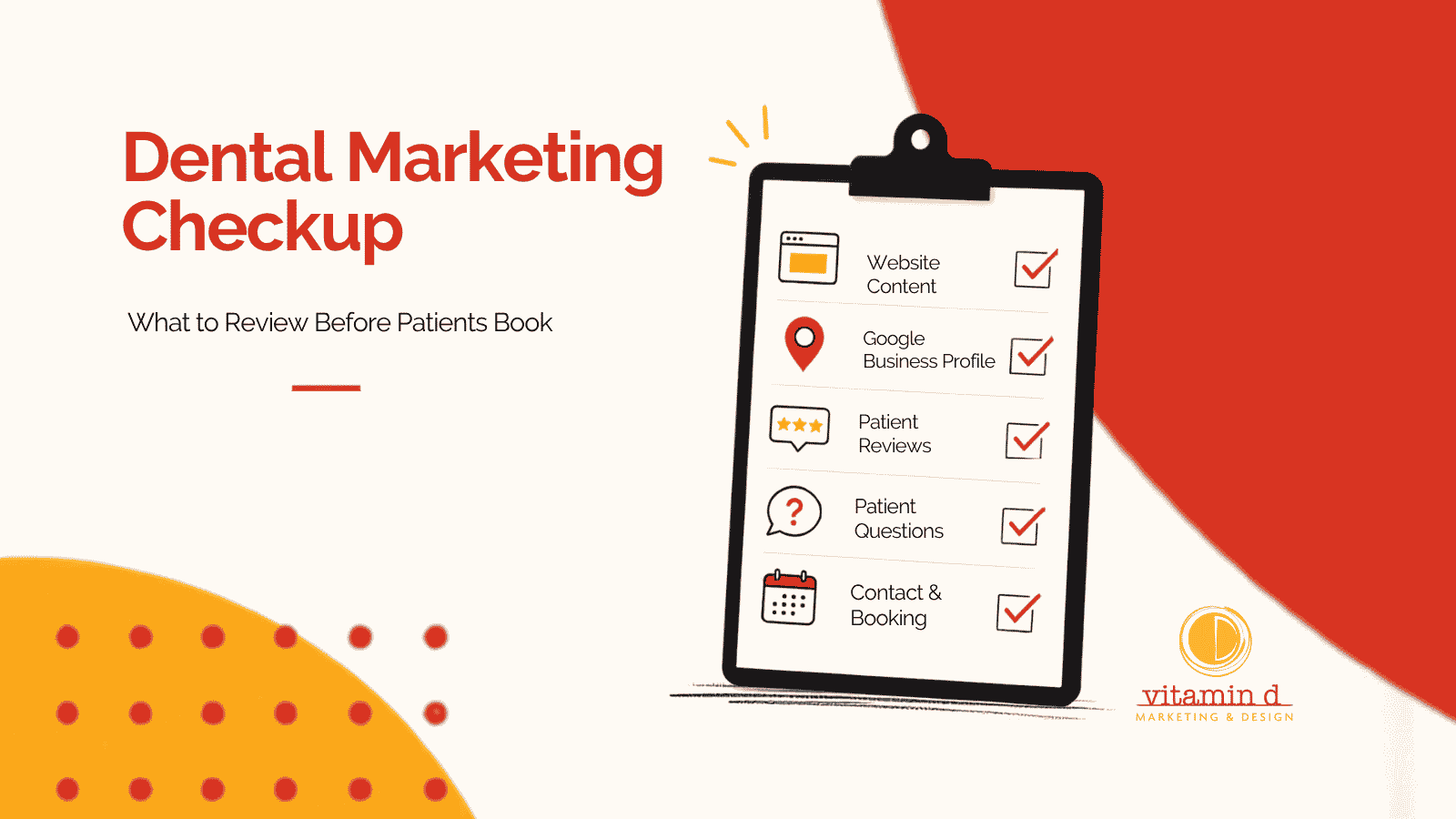
Patients are doing more research before they book a dental appointment.
They may be searching for symptoms, comparing services, reading reviews, checking your location, looking through your website, or trying to understand whether your practice feels like the right fit. Some patients may also be using AI tools to research their options before they contact a clinic.
That means your online presence has a lot of work to do.
Good dental marketing should help future patients find your practice, understand your services, trust what they see, and feel confident taking the next step. A simple dental marketing checkup can help you spot gaps before they become missed opportunities.
Why a Dental Marketing Checkup Matters
Dental marketing is not just one thing.
Your website, Google Business Profile, reviews, service pages, contact information, social media, and local SEO all shape how patients see your practice online.
If those pieces are clear, current, and consistent, they can help build confidence before someone calls or books. If they are outdated, confusing, or disconnected, patients may move on without ever contacting your office.
A marketing checkup gives you a practical way to review what future patients may see before they decide to reach out.
The goal is not to make everything perfect overnight. It is to understand where your online presence is helping, where it may be creating friction, and what should be improved next.
Check Your Website Content
Your website is often one of the first places patients go when they want to understand your practice.
A strong dental website should do more than list services. It should help patients quickly answer questions like:
- Where is the practice located?
- What services are offered?
- Is the practice accepting new patients?
- What does the patient experience feel like?
- How do I contact the office or request an appointment?
Are your services easy to understand?
Review your main service pages and ask whether they are written in a way patients can actually understand.
For example, a patient may not know what “endodontic treatment” means, but they may understand “root canal treatment.” A service page should make the treatment clear without overwhelming the reader with clinical detail.
Helpful service pages can support both patient confidence and dental SEO because they give people and search tools clearer information about what your practice offers.
Is your contact information clear?
Patients should not have to hunt for your phone number, address, hours, or appointment request option.
Check whether your contact information is easy to find on desktop and mobile. Also make sure it matches what appears on your Google Business Profile and other online listings.
Small inconsistencies can create confusion, especially when patients are comparing multiple practices.
Are your calls to action easy to follow?
Every important page should help patients understand what to do next.
That could mean calling the office, requesting an appointment, learning more about a service, or contacting the team with a question.
A clear call to action does not need to be aggressive. It just needs to be easy to find and easy to understand.
Review Your Google Business Profile and Local Presence
For many dental practices, the Google Business Profile is one of the most important parts of local visibility.
Patients may see your profile before they ever visit your website. They may use it to check your hours, read reviews, get directions, call the office, or compare your practice with others nearby.
Confirm your basic information
Start with the basics:
- Practice name
- Address
- Phone number
- Website link
- Hours
- Services
- Appointment or contact options
If your information is outdated or inconsistent, patients may lose confidence or contact the wrong place. It can also make your local presence less clear.
Review photos, services, and updates
Your Google Business Profile should help people understand what your practice is like.
Current photos, accurate service information, and regular updates can all support trust. Patients often want to see signs that a practice is active, professional, and easy to contact.
This does not mean your profile needs constant attention every day. But it should not look neglected.
Check consistency across platforms
Your practice information should be consistent across your website, Google Business Profile, social media profiles, directory listings, and review platforms.
This matters because patients may find you in more than one place. If your hours, address, phone number, or service details vary from platform to platform, it can create doubt.
Consistent information supports a better patient experience and stronger local SEO.
Look at Your Reviews and Trust Signals
Reviews play a major role in how patients evaluate dental practices online.
Before booking, a patient may look at your rating, read recent reviews, check how people describe the team, and compare your practice with others in the area.
Reviews help shape patient confidence
Strong patient reviews can help future patients feel more comfortable reaching out. They can also reinforce important details about your practice, such as friendliness, professionalism, communication, comfort, or care quality.
A review checkup can include:
- Are new reviews coming in regularly?
- Do the reviews reflect the patient experience you want to be known for?
- Are there recurring themes, positive or negative?
- Are responses professional and appropriate where needed?
Reviews are not just a marketing asset. They are part of the trust-building process.
Your website should also support trust
Trust signals are not limited to review platforms.
Your website can also build confidence through:
- Team bios
- Practice photos
- Clear service explanations
- Patient-friendly language
- New patient information
- Financing or insurance information, if applicable
- Before-and-after galleries, if appropriate and compliant
- Clear contact options
These details help patients understand who you are, what you offer, and what they can expect.
Make Sure You Are Answering Real Patient Questions
Patients often search because they have a question.
They may want to know why their gums are bleeding, whether they need a root canal, what options exist for replacing a missing tooth, how Invisalign works, or whether a dental concern is urgent.
Your marketing should help answer the kinds of questions your future patients are already asking.
This can happen through:
- FAQ sections
- Service pages
- Blog posts
- Google Business Profile content
- Social media posts
- Clear website copy
Helpful answers matter for people first. They also matter for search.
As search behaviour changes, clear and trustworthy content can help search engines and AI-influenced tools better understand who your practice helps, what services you offer, where you are located, and why someone may want to contact you.
That does not mean writing content only for algorithms. It means writing content that is useful, specific, and easy for patients to understand.
Check Whether Your Marketing Pieces Work Together
A dental practice’s marketing works best when the pieces support one another.
Your website, SEO, Google Business Profile, reviews, social media, and advertising should not feel disconnected. They should all support the same basic goal:
Help the right patients find your practice, understand your services, trust what they see, and contact you when they are ready.
For example:
- Your service pages can support SEO and help patients understand treatment options.
- Your Google Business Profile can support local visibility and make it easier to call or get directions.
- Your reviews can support trust before someone books.
- Your social media can build familiarity and keep your practice visible.
- Your website can bring everything together and guide patients toward the next step.
When these pieces work together, your marketing feels more organized and more useful to the people seeing it.
A Dental Marketing Checkup Does Not Need to Be Complicated
A marketing checkup does not need to be overwhelming.
Start with the basics:
- Is your website current?
- Are your services clear?
- Is your Google Business Profile accurate?
- Are your reviews helping build trust?
- Is your contact information consistent?
- Are you answering real patient questions?
- Do your marketing pieces support one another?
These simple questions can reveal a lot.
The goal is not to chase every trend or change everything at once. The goal is to understand what your future patients may be seeing before they book and make sure your online presence is helping them feel confident taking the next step.
A quick checkup can help you see what may need attention. If your dental practice wants support reviewing your website content, SEO, local visibility, reviews, or broader digital marketing strategy, Vitamin D Marketing & Design can help.
Dental Marketing Checkup FAQs
What is a dental marketing checkup?
A dental marketing checkup is a simple review of the main pieces that shape how patients find and evaluate your practice online. This can include your website, Google Business Profile, reviews, service pages, contact information, social media, and local SEO.
The goal is to see whether your dental marketing is making it easier for future patients to find your practice, understand your services, and feel confident reaching out.
How does website content support dental SEO?
Website content helps patients and search engines understand what services your practice offers, where you are located, and how you can help.
Clear service pages, FAQs, and patient-friendly explanations can support stronger dental SEO while also making your website more useful for real people.
A strong dental website should not only look professional. It should answer common questions and guide patients toward the next step.
When should a dental practice ask for marketing support?
A practice may want support when its marketing feels outdated, inconsistent, difficult to manage, or disconnected across platforms. It is also useful to partner with a dental marketing expert for a brand new clinic or when ownership changes hands to get the ground work laid out well for the business with best practices from the get go.
A quick checkup can help you see what may need attention. If your dental practice wants support reviewing your website content, SEO, local visibility, reviews, or broader digital marketing strategy, Vitamin D Marketing & Design can help. Contact our team to talk with us about strengthening your dental marketing.
Written by: Emily Grove